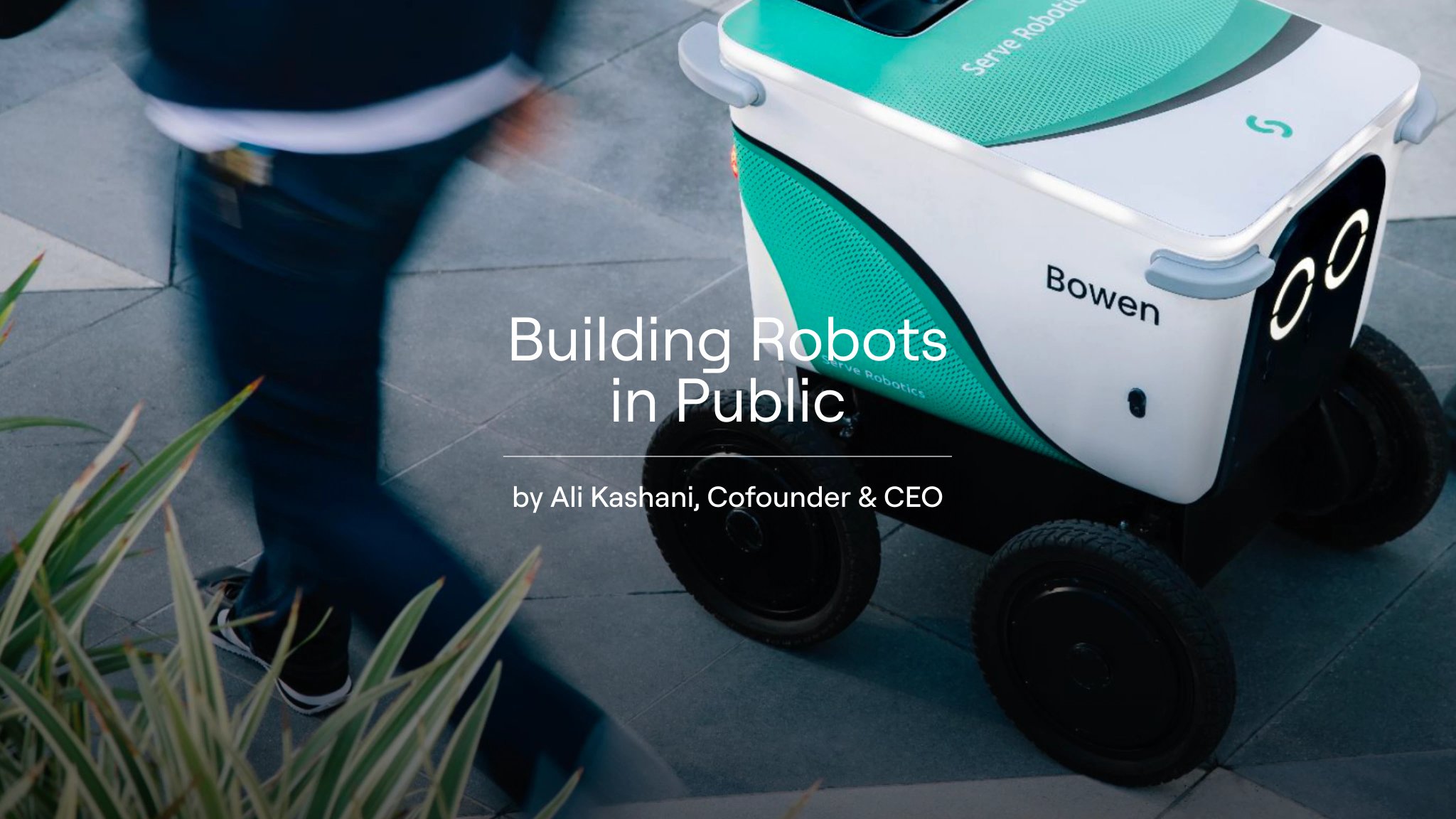
Building Robots in Public
Building Robots in Public
Article
Building Robots in Public
by Ali Kashani, Co-founder CEO
Every day, Serve robots travel more miles than it takes to walk from New York to Los Angeles. When your robots cover that much ground each day, they’re bound to run into unforeseen problems.
In a recent post, I described startups as entropy-reduction engines converting unknown unknowns into knowledge. Solving the problems robots face every day is exactly that.
Many founders are choosing to “build in public”; that is, to share their product decisions, metrics, and missteps in real time. But when your product is an urban robot, you don’t have a choice: You’re building on public sidewalks, and everyone gets to watch.
When unknown unknowns are televised
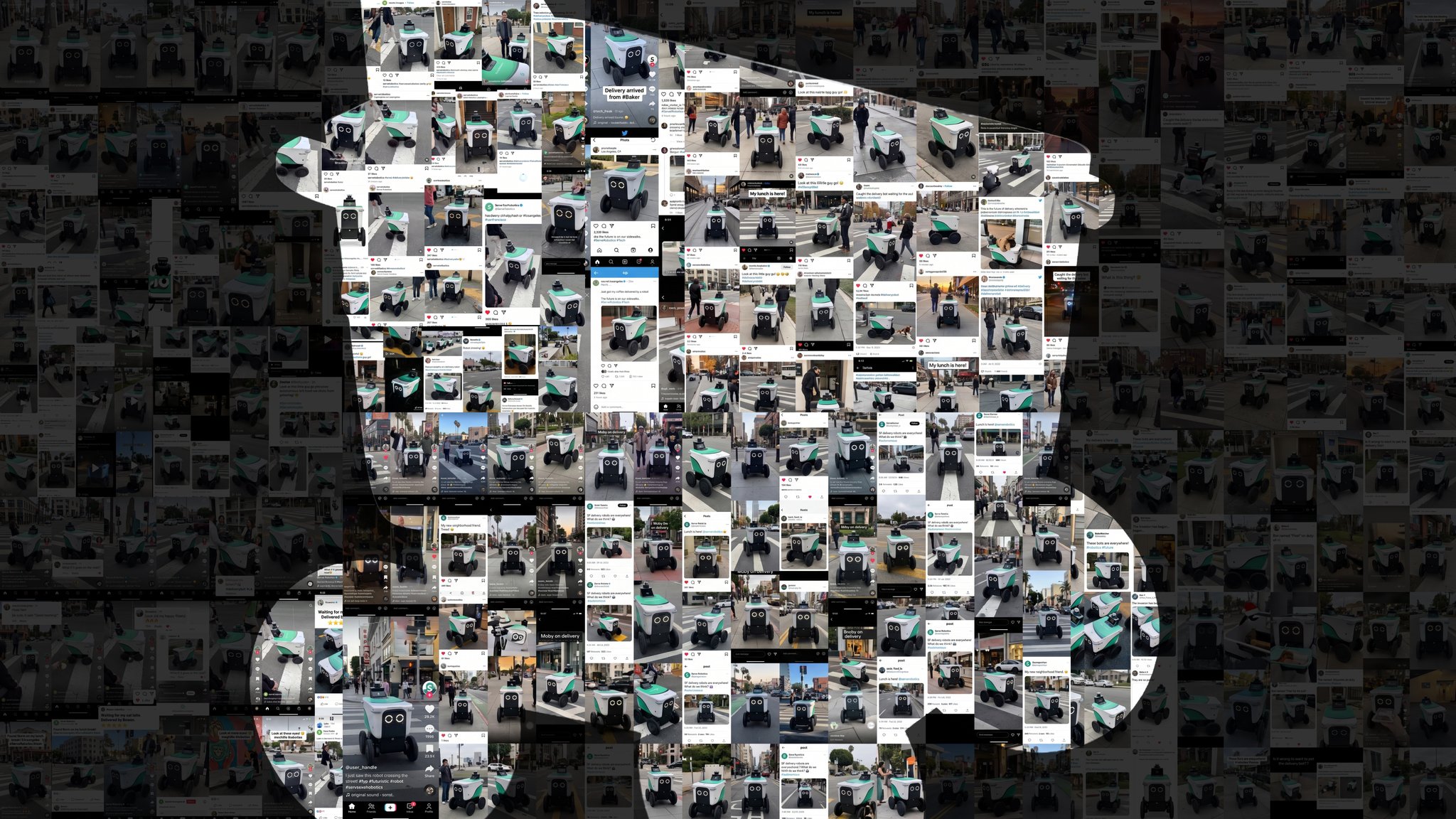
In software, an edge case might throw an exception. In urban robotics, it goes viral.
One robot escapes a kidnapping attempt. Another navigates around a bike thief. One crosses police tape after someone waves it through, while another tries (and fails) to pass through glass. Meanwhile, influencers chase robots to lick them, or scream at them, for likes and clicks. Each clip travels faster than the context behind it.
The statistical rarity of these events matters less than their visibility. When Serve robots pick up orders, they successfully deliver them to customers 99.8% of the time, an exceptional level of reliability that’s almost an order of magnitude higher than last-mile deliveries completed by couriers. But with delivery robots, novelty amplifies exceptions.
The most important question here is not how to react to each individual incident, but what framework to use to deal with unpredictable events that are inevitable.
Principles for making in public
On the sidewalk, uncertainty is the only constant. The question is not whether something unexpected will happen, but how you make decisions when it does. I have found that in times like this, a few of our company values do the heavy lifting:
1. Principle before perception
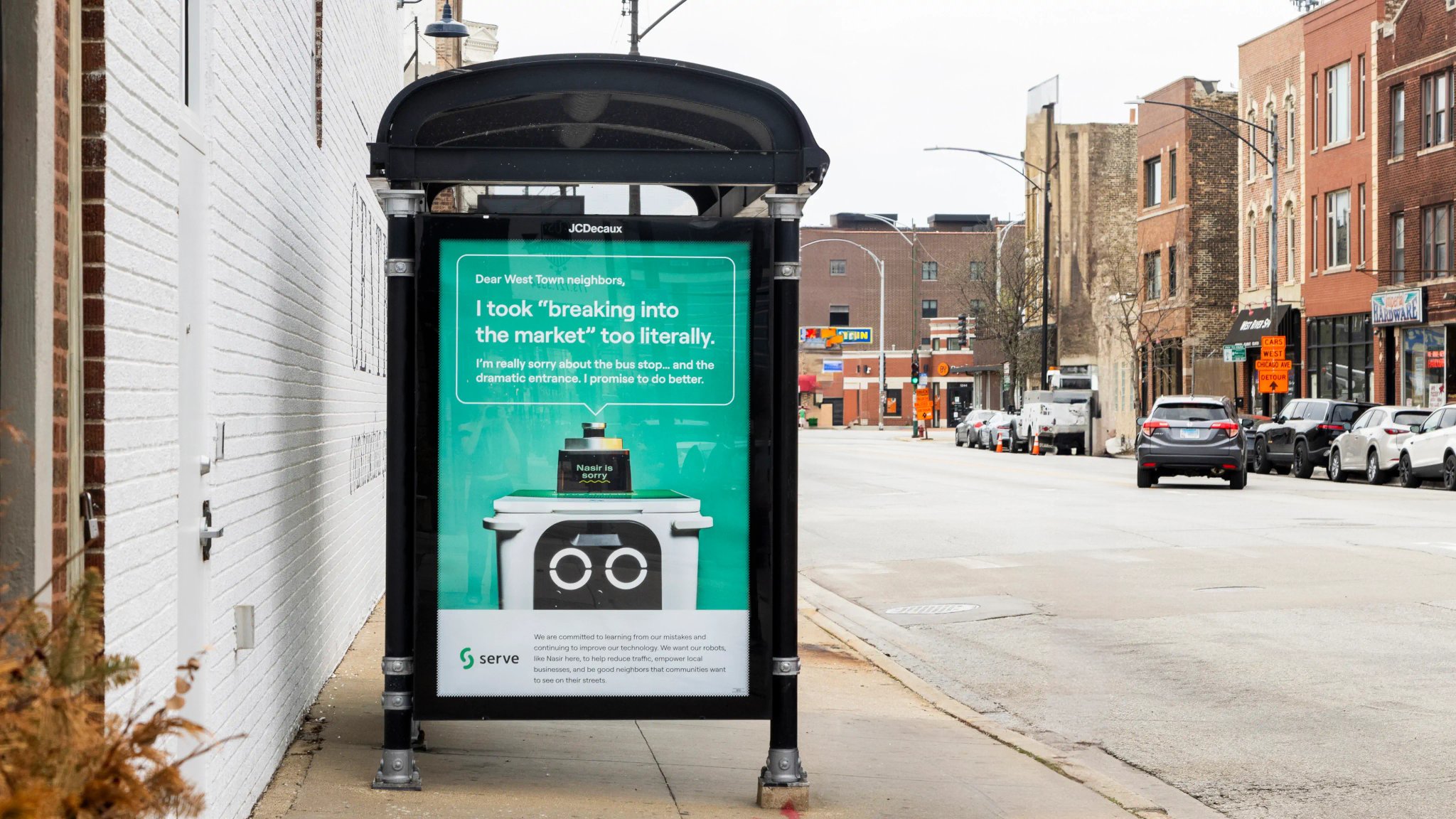
When something unexpected happens, the gravitational pull is toward optics. Humans are social creatures after all, and tend to worry a lot about their reputation. Often this can result in behavior that is detrimental. Focusing on saving face can take away from our ability to learn, which is critical in startup success.
When faced with a problem, people often try to solve two things at once: how to fix the problem itself, and how to make sure they don’t look bad. But when looking for a solution, starting with too many constraints limits our thinking; if we’re looking for a solution that both solves the problem at hand as well as absolves our reputation, it often means we fail to thoughtfully consider the larger solution space. This is why at Serve we insist on focusing on one problem at a time:
- 01First, put concerns about optics aside and solve the problem. Knowing everything we do now, what is the right thing to do here?
- 02Only after that question has been answered, deal with optics and messaging. With the clarity of the solution at hand, often managing optics simply comes down to communicating the facts and our thought process with clarity and thoughtfulness. As it turns out, sound, principled decisions are easy to defend!
We call this “PRINCIPLE BEFORE PERCEPTION,” and it is a fundamental operating principle. What matters most to any startup’s long term success is the quality of the decisions. Good decisions will withstand scrutiny. But allowing optics and perception to drive decisions leads to suboptimal decision making; in turn, over time that always makes managing optics even harder. On the other hand, removing optics from decision-making improves clarity.
2. Safety is not negotiable
When building and deploying autonomous machines in public, the first principle is to always ground decisions on safety. Building robots that operate next to people demands safety and transparency to be the top concern. When scrutiny comes, and it inevitably does, only a culture rooted in safety will withstand it.
“SAFETY IS NOT NEGOTIABLE” is the first value our new hires learn about. It means that we methodically aim to reduce safety risks. We review every incident with one goal: how do we get better? The example we follow is that of the aviation industry that has managed to achieve miraculous levels of safety, by making every incident a learning opportunity.
The choice to build sidewalk robots in the first place is motivated in large part by safety. There are around 40,000 traffic fatalities per year, and cars and trucks have only become larger with narrower sightlines. Without robots, goods move in larger, faster, and far heavier vehicles—cars and vans weighing thousands of pounds and operating at speeds where small mistakes can have serious consequences. As e-commerce has grown exponentially in the past decade, our cities are increasingly full of box trucks and burrito taxis. Our robots weigh about 200 lbs and move at 3~5 mph, closer to the pace of a pedestrian than a vehicle. That difference matters. Lower mass and lower speed inherently limit the potential severity of any interaction, and our systems are designed to further reduce risk through continuous awareness, conservative navigation, and immediate fail-safe stopping when uncertainty arises.
With robots, we can reduce society’s reliance on vehicles and make cities safer than we found them. We are shifting deliveries away from the highest-risk modes and toward something fundamentally more forgiving. In that sense, autonomous sidewalk robots are not just a new way to move goods; they are a way to make cities themselves safer over time. And that is something that motivates our team to view every incident as an opportunity to strengthen our safety culture.
3. Be authentic, passionate, and kind
Another value that underlies our decisions is being “AUTHENTIC, PASSIONATE, AND KIND.”
In practice, that means remembering that while the robots are autonomous, we, the people behind them, are not. We are responsible for how robots show up in people’s daily lives.
Authenticity means not defaulting to scripts. When something happens, speak plainly about it, admit when mistakes are made, and do what we promise to do. It also means not pretending we have everything figured out. We won’t always get it right the first time. But we can listen to feedback and get better.
Passion means believing this work matters: Safer, lighter, electric delivery can make cities better. Over time, we have to be willing to do the hard, often invisible work to earn the trust required to make this vision into a reality.
Kindness means being a good neighbor. It means listening to feedback and offering to help. In West Hollywood, for example, residents had flagged a blind corner where cars turning left often cut across an unprotected crosswalk. People raised concerns and our robots backed them up with real street-level data. We take a similar collaborative approach to accessibility. Whether that’s flagging gaps in infrastructure or continuing to refine how robots move and communicate around people with different mobility or sensory needs, we’re cognizant that cities and sidewalks are for people first.
4. Deliver Delight
“DELIVER DELIGHT” is easy to interpret narrowly as exceeding expectations. When making robots in public, it has a broader meaning.
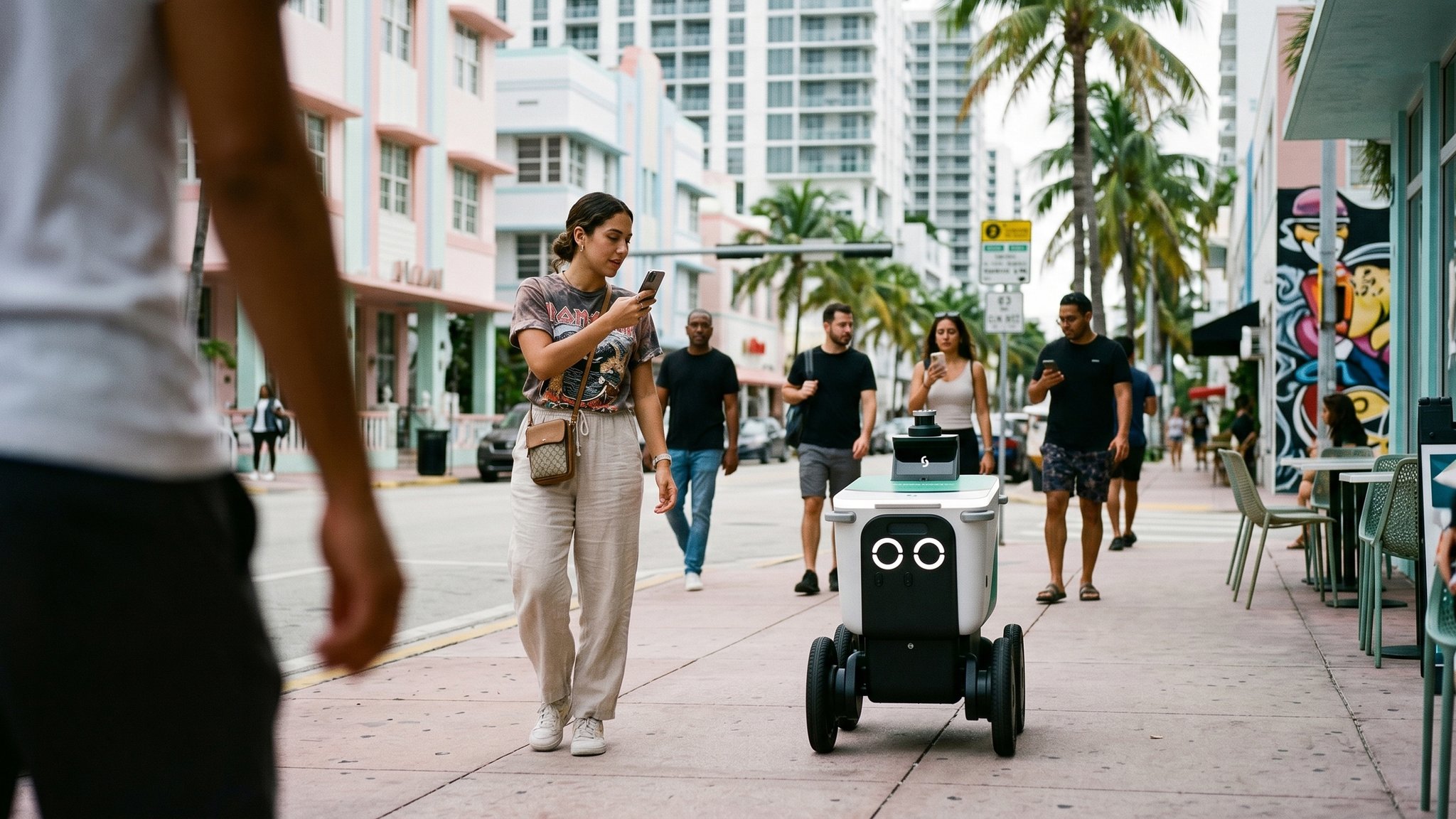
Delight is not just about a successful delivery; it is about how our presence feels on the sidewalk, and how we present ourselves as neighbors. To reach every customer, robots interact with tens of pedestrians along the way. Delivering delight means designing AI that works well around them; robots that are friendly and predictable.
It also means responding to incidents in ways that reduce tension rather than escalate it, like choosing generosity over defensiveness when possible. In a high-visibility environment, delight is a choice to build durable goodwill in our communities.
Building in public requires discipline
Being in public spaces compresses timelines. The world judges you in seconds, but engineering takes longer. The only sustainable posture is disciplined adherence to your principles. Look for the truth, learn rigorously, and make decisions based on your principles and values, not in fear of optics and perception. And whenever necessary, communicate thoughtfully.
While startups reduce entropy, building in public requires doing so under a microscope. If done right, this can be turned into a function that forces a company to think clearly about its values and behaviors. Ultimately, this can result in technologies and products that better serve everyone.
The real world is a tough place. It’s much less predictable than anything we could imagine in a lab. Putting robots on city streets means dealing with all these uncertainties and more. But that’s the job we signed up for.
If you see our robots in your neighborhood and have feedback—positive or critical—I encourage you to reach out to us at contactserve@serverobotics.com or leave a comment.
This essay was originally published on Substack. You can read and subscribe here.